Balduque

Sometime in the 16th century during the reign of Carlos I, Spanish officials created the term balduque — otherwise known as “red tape”.  This word was coined in response to the mountains of reports, administrative documents, dossiers, and the like that were generated throughout Spain and its imperial realm.

Originally, balduque (*) referred to a wide red string tied around reams of paper deemed important enough to reach el rey.  All the other piles of paper were tied with rope and never got a chance to visit the king.  Though “red tape” is still used in much of the English-speaking world, the term balduque has faded in Spain, replaced by the more pedestrian papeleo burocrático.   Here is what it looks like:

P1010430

Only the half of it.

You may recall a point in your life when you stood in line at the Department of Motor Vehicles.  Maybe you applied for Obamacare and had to fill out a few forms.  Way, way back you may even have completed a financial aid application for college, submitted it on time, and later waited some minutes at the bursar’s office.  Ha!

To live in Spain is first to figure out how to get a number and next where to stand in line, only to be informed that you have to go to a different office in another part of town, which will be closed between 2 and 5 p.m.  (No one knows exactly where this oficina is, by the way.)  Through experience we know that you have to get to this other office by 9 a.m. in order to get an appointment for 11:30 a.m. later that day.  At the appointed time you must hand over all the forms {^} you have previously submitted (multiple times) to get a visa[%], to receive packages from the States, to register children to play on the local fútbol team, to open a bank account, or to receive your Residency Card.

At the Oficina de Extranjeros, no one speaks English — nor, for that matter, any language other than Spanish.  Why should they?  It is simply the office that processes the many papers needed by foreigners from all over the world who want to reside in Spain.  At the Agencia de Tributaria, M. felt guilty for not knowing enough Spanish, but still managed to make an appointment, return at the proper time, go to the correct desk, hand over the proper forms and then receive this print out from the nice Spanish-speaking lady.

P1010453

The nice Spanish-speaking lady gave M. this special form.

 M. still does not know what to do with it.

Regardless, the system works, because later our maletas arrived from the United States thanks to Y., back in Pasadena, and thanks to the patient civil servants at the Oficina de Aduana in Madrid.

photo

These were almost sent back to the States because no one could tell us the proper office to submit our forms.

At the end of September, we learned that our long-term residency visas had been finalized and our residency cards had been processed.  We took a taxi to the Oficina de Extranjeros to pick them up.  The residency card includes the important Número de Identidad de Extranjeros, or NIE (pronounced “nyee”):  As in, “I went to the Oficina de Extranjeros to pick up our NIEs and found out I need to come back next Thursday with the kids.”

Yippeee!!!!

Yippeee!!!!

 The NIE is like a magic get-out-of-jail card.  You use it to open a bank account, to order groceries, to sign kids up for field trips, to rent a car, to receive the Empadronamiento (don’t ask), to get library cards, to pay rent, to sign up for lunch and pay for activities at school, and it works great as a toothpaste, floor cleaner and cream rinse.

Like the many Spaniards who have learned to live with papeleo burocrático, we stand in line with our well-burnished paciencia y tranquilidad.  To see what this attitude looks and feels like in real life, please check out this YouTube video:

(*) We are obliged to inform you that the term “balduque” does not actually mean red tape.  That term, of course, is the simple nomenclature cinta roja.  Instead, “balduque” derived from a city in the Spanish Netherlands from whence the red tape was manufactured.  That city was called ‘s-Hertogenbosch, which for some reason the Spanish called “balduque.”  (At this point, the post you are reading has descended to a level of minutia that is essentially devoid of interest.  Please take a number to submit your complaint.(*))

{^} List of necessary forms/documents[+]:  copy of passport, criminal background check with finger prints, U.S. bank statement, medical record, birth certificate (children), letter of current employment, visa application, vaccination record (children), residency form EX-01, lease, domestic partnership certificate, driver license, declaration of medical benefits, Modelo 790.  ((*) Your complaint must be submitted in Spanish by a Certified Spanish Translator (#).)

[+] The following documents must be taken to the office of the Secretary of State of the State of California to receive the International Stamp of the Apostille (by agreement of the “Convention de La Haye du 5 octobre 1961) before they will be accepted by the government of Spain:  birth certificate, domestic partnership certificate, criminal background check.  ( (#) Please resubmit your complaint with embossed notary seal indicating legal authentication of translator’s certified status. (&))

[%} When applying for our visas, the clerk at the office of the Secretary of State in downtown Los Angeles at first refused to accept the birth certificates that were signed by the doctors who delivered A. and J.  M. needed to return with copies of birth certificates signed by the County Clerks of the respective counties — Alameda and Los Angeles.  ((&) Have you submitted the above mentioned form in duplicate copies in Spanish as well as in English?)

Passports with visas to Spain!

Passports with visas to Spain!

48 Hours in Córdoba

From its heyday as the go-to center of learning and multicultural consonance  — while the rest of Europe trudged through the “Dark Ages” — to its current status as a magnet for tourists seeking a glimpse of its Muslim/Catholic/Jewish past, Córdoba is a city not to be missed.  Truth be told, of all that Córdoba has to offer, there is only one irritation:  You must hold down the “o” key, then strike the appropriate letter (out of a choice of eight), in order to indicate the accent mark every time you type the name of this former Islamic capital of the Iberian Peninsula.  For that reason, we will be referring to Córdoba as C. for the remainder of this post.

P1010119

Sign for Córdoba Centro with annoying accent mark.

At the beginning of November, we took a quick two-night trip to C.  We had heard wonderful references to the Mezquita and were intrigued to find out what the judería was all about.  With only 48 hours to spare, we embraced our roles as tourists and stuck to the major attractions.

{Click on photo for view of major attractions that C. has to offer.}


Mezquita:  No visit to the Mezquita would be complete without a prior Wikipedia search under the heading “Mosque-Cathedral of Córdoba.”  A brief summary follows:  Constructed over a period of 200 years (785-987 C.E.), this grand mosque (built on the previous foundation of a Visigothic house of worship) was transformed into a church after yet 300 more years of diligent work (1236-1520? C.E.).  We finished this baby off in a mere 65 minutes.


Alcázar:  Completed in the 14th century under the auspices of Alfonso XI, this Castle of the Christian Monarchs sits atop the remnants of previous Roman and Arab civilizations.  It was here that Christopher Columbus first met King Ferdinand and Queen Isabel in 1486.  A. & M. successfully navigated the Tower of the Lion, the Tower of the Inquisition, the Keep, the Mosaics Hall, the Moorish Patio, and the Gardens in 43 minutes. (We did not visit the Royal Baths.)


Judería:  There is nothing funny to say about the judería.  Even the accent mark isn’t funny.  Yes, a thriving Jewish intellectual and mercantile life existed before the rise of Reyes Católicos (aka, Ferdinand and Isabel), and yes, the study of Judaism flourished, and yes, the great 12th century philosopher-doctor-jurist Moses Maimonides called C. “home” (or more likely “لبيت”) [until he was forced into exile], but like many historical sites in C., all that is in the past.  Try to find a bagel and cream cheese in contemporary C.?  Forget it.

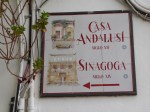
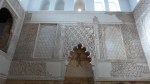
Still, we made our way to the small 14th century sinagoga and toured Casa de Sefarad, a museum devoted to the life and times of los judios during what is called the Islamic Golden Age and during the subsequent “Reconquista.”  (Occasional massacres, pogroms, and expulsions excluded from exhibit.) Time spent in the judería:  Eleven hours, 42 minutes.


The remainder of our time was spent sleeping, eating, preparing to leave the apartment for outings, and experiencing the spontaneous combustion of travel.   Transpired time:  A vigorous thirty-four hours, 30 minutes.

Total time spent in C.: 48 hours.  Perfecto!
Picos de Europa

1.) Where is Picos de Europa?  That is the question we sought to answer.  You will find it, as we did, in the north of Spain, straddling two beautiful provinces: Cantabria and Asturias. 

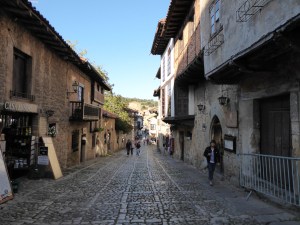
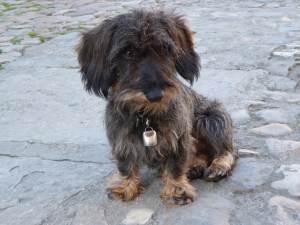
2.)  How does one get there?  We chose the following way:  We first moved to the Albayzin in Granada, Spain.  We then walked down to Plaza Nueva and took a taxi to the bus station. We rode on the bus for two hours to the southern beach city of Málaga where we could catch a direct flight to the northern beach city of Santander.  A rental car awaited us.  We drove through the quaint stone village of Santillana del Mar, where we sampled some local delights:  fresh, raw milk from grass-fed cows, the baked treats sobao, bizcocho, and quesada, and the attention of very cute dogs.  Our next stop was the idyllic town of San Vicente de la Barquera.

3.)  Why does the town of San Vicente de la Barquera remind visitors of the gorgeous northern California coast?  This is because the town spreads from the beach to the hills; the estuary of Río Escudo ebbs and flows with the tides.  True, the large stone Iglesia de Nuestra Señora de los Ángeles and the Castillo del Rey, both from the 13th century, dominate the skyline (in place of familiar San Francisco sites such as the Transamerica Pyramid and Coit Tower, both from the 20th), and granted the real estate is cheaper than any place on the California coast, and it is well acknowledged that the population density is a mere 280 people/sq. mile, as opposed to San Francisco’s 18,187 people/sq. mile, but both municipalities feature saints in their names and a decent cup of coffee can be procured as easily in one as in the other.

4.)  Did you visit the cave of El Soplao and did you order the chicken nuggets in the cafe in the hopes of Jonah finally agreeing to eat something?  Yes.

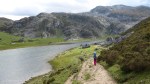
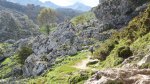
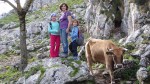
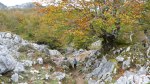
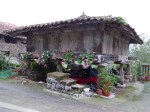
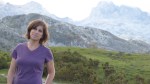
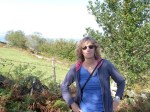
5.)  What does one do in the Picos de Europa?  Most people work, raise families, rest and relax.  We decided to complete a ropes course in Arriondas, visit a church in Covadonga, take a hike along Ruta de los Lagos, explore the Asturian town of Cangas de Onís, and stay in the tiny farming settlement of Cabielles.  

6.)  On a scale of one to ten (ten being the highest score) how would you rate this trip and why?  We would rate this trip a solid ten.  Reasons why:  Only one person out of four threw up on the windy roads of the Picos.  We had an opportunity to walk across a Roman bridge, built in the 13th century, which was chronologically impossible, but still a treat (see Gibbon, Edward.  The History of the Decline and Fall of the Roman Empire.)  We were also able to get good reception at our rural lodging and watch Spain defeat Luxembourg (4-0), thereby qualifying for the 2016 Euro tournament to be held in France starting in June (2016).   


“Gracias por pedir el pescado.”

P1000975