Professional fútbol in Granada: a grueling game for men.


Semi-professional fútbol in Granada: a grueling game for women.


Youth league fútbol in Granada: a nightmare that never ends.


Even though J. and A. had signed up to play with the local fútbol club, Rayo Eneas, trouble in Barçelona had prevented them from participating in official games with their teams.
It all began when the Barçelona FC was fined for enticing young players from other countries to move to Spain and try out for the Barçelona team. According to newspaper accounts, up to 3,000 young people have been abandoned on the streets of Barçelona having failed to reach the pitch, disclaimed without family or friends to help them.
To prevent the continuation of this “child-trafficking” FIFA is cracking down on the parents of foreign children who play on European teams. Hence, a bunch of ex-pat kids have been left on the sidelines, able to train but unable to play until their paper trail is examined, codified, stamped, stapled, rejected, resubmitted and…….
-

- Let him play!
. . . Éxito! In December, J.’s coach finally figured out a way for J. to play while his papers were being processed! Now we get to schedule every single weekend around fútbol games — either home or away in a nearby pueblo. As of this posting, Rayo Eneas is in 2nd place with a 12-1 record. J. has scored a couple of goals and is glad to play midfield or defense. Vaya Rayo Eneas!
-
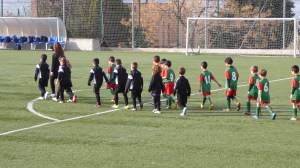
- Keep your eye on # 6.
Ultimately, FIFA took so long to authorize all the forms that our empadronamiento expired and D. had to return to the Centro Civico at the Oficina de Ayuntamiento in the Albayzin to renew our copy. This was great because we got to practice one of our favorite phrases in Granada: No pasa nada.
A., on the other hand, has yet to play in an official game. Her forms have not been processed. Her empadronamiento rests in an office, somewhere in the city, awaiting its stamp. However, A. couldn’t care less. She is happy enough to practice with her team twice a week, one of only three girls willing and able to play fútbol with the boys.
-

- No pasa nada…





 pomegranate2015