FUN FACT: “[Lisboa] is a city founded and named by Ulysses as Ulissipo or Olissopo, which has its origins in the Phoenician words ‘Allis Ubbo’, meaning ‘enchanting port’. It is from there, according to legend, that Lisbon got its name” (Brief History of Lisbon).
Thus did we make our way up the coast of Portugal to Lisbon, crossing the mighty Tagus River atop Ponte 25 de Abril* from the south, hanging tight on the A2, somehow taking a wrong turn onto the E1 and heading out to the airport, then back into the city again from the north and eventually to our lodgings at a time of great importance: the 2016 UEFA European Football Championship game between France and Portugal held in Stade De France in the northern commune of St. Denis in Paris.
WHY WE STOPPED IN LISBON

Best restaurant in Lisbon!
* 25 de Abril – The Carnation Revolution : the 1974 non-violent military coup which overthrew the authoritarian Estado Novo regime *. * The Estado Novo regime – The Second Republic of Portugal, beginning in 1933 that featured a corporatist form of government. * * Corparatism — A political ideology which promotes the organization of society by corporate groups, such as agricultural, labor, military, scientific, or guild associations on the basis of their common interests.* * Common Interest — The opposite of what this blog post you are reading has devolved into.
Not only was Cristiano Ronaldo forced to leave the pitch in the 25th minute (in tears) due to injury, but the game also remained scoreless until the 99th minute (in overtime), at which point, Portuguese substitute Eder struck the ball 25 yards out for what became the winning goal. At game’s end a great explosion of sound criss-crossed Lisbon consisting of horns tooting, people singing, bottles breaking, music blasting, cars revving and the soft whishing sounds of the Portuguese flag heralded by many a joyous Portugese.


FUN FACT: “An area of former royal summer residence, Sintra possesses a beauty that was celebrated by Lord Byron in his poem Childe Harold’s Pilgrimage, and English author Robert Southey referred to Sintra as ‘the most blessed spot on the whole inhabitable globe.’ Sintra was designated a UNESCO World Heritage site in 1995″ (Britannica.com).
Thus did we take the subway to Rossio Station*, boarding the line to Sintra and arriving forty minutes and 25 kilometers later to arrive at one of Sintra’s most significant destinations.
WHY WE STOPPED IN SINTRA
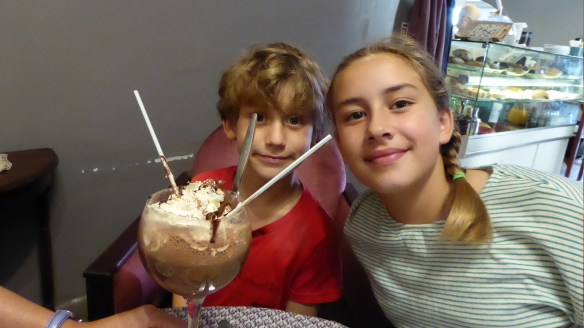
First stop in Sintra!
* Rossio Station – Situated in Rossio Square, one of the main squares of Lisbon since the Middle Ages. The name “rossio” is equivalent to the English term “the commons”, and refers to commonly owned terrain, making it an ideal location for executions during the Inquisition,* the first one of which took place in 1540. On a lighter note, according to Wikipedia, “On 3 May 2016, a 126-year-old statue of Sebastian of Portugal that stood in a niche between the entrance portals was accidentally destroyed by a person who knocked it over by climbing up for a photograph. The person was arrested.” * The Inquisition – In Portugal, targets were primarily conversos, suspected of secretly practicing Judaism while disguised as Catholics. Many of these were originally Spanish Jews, forced out of Spain during the Spanish Inquisition. Ultimately, a bummer.* * Bummer – The current tone of this footnote.
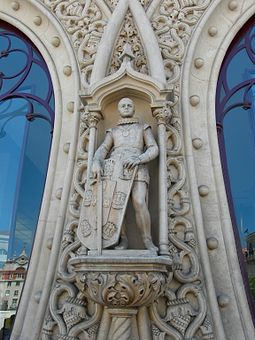
The aforementioned statue, now destroyed.
Delights beyond ice cream awaited us, as Sintra was (and perhaps remains) the go-to playground for the rich and famous, once the Moorish rulers were finally defeated sometime in the 12th century. Great was our delight as we gazed from afar at the structural beauty bestowed upon We the Public and “rubbed shoulders” with the literati of the 19th century (or at least pawed at their commemorative placards).


In Sintra, we wandered through Quinta da Regaleira, a place of fancy, marvel, whimsy and water and which can be investigated thoroughly via this web site: https://en.wikipedia.org/wiki/Quinta_da_Regaleira.


All in all, a great place to visit!


FUN FACT: “Expo ’98 (Exposição Internacional de Lisboa de 1998) was an official specialized World’s Fair held in Lisbon, Portugal from Friday, 22 May to Wednesday, 30 September 1998. The theme of the fair was ‘The Oceans, a Heritage for the Future’, chosen in part to commemorate 500 years of Portuguese discoveries. The Expo received around 11 million visitors in 132 days, while 143 countries and many organizations were represented” (https://en.wikipedia.org/wiki/Expo_%2798).
Thus did we board the Metro and make our way underground to Estação do Oriente in order to witness the many discoveries* that Parque das Nações (the Park of Nations) had to offer.
WHY WE STOPPED AT PARQUE DAS NAÇÕES
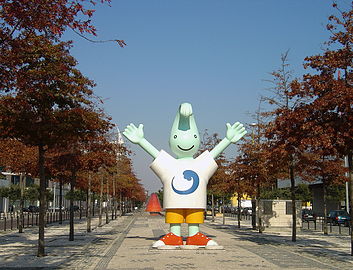
Mascot “Gil” selected from over 300 entries!
* Discoveries — From the beginning of the 15th century until midway through the 17th century, this period was known as the Age of Discovery or the Age of Exploration, initiated by Portuguese explorers* such as João Gonçalves Zarco, Tristão Vaz Teixeira, Lourenço de Almeida, and dozens of other men whose names are difficult for us to spell (except for Vasco da Gama which isn’t really all that hard). * * Portuguese explorers — Notably Infante Dom Henrique of Portugal, more familiarly known as Henry the Navigator, is credited with bankrolling those first forays into commercial exploration and colonization of the African coast that led to the African slave trade *, trans-Atlantic trade routes, and the discovery of numerous lands previously discovered by the people who were actually born in those said lands. * The African slave trade — See Roots, by Alex Haley, The Middle Passage, by Charles R. Johnson, Kindred by Octavia Butler, Beloved by Toni Morrison, along with hundreds of other books, paintings, monographs, documentaries, songs, interviews, dance pieces, poems, sculptures, blog posts* and graffiti that continue to describe and define the experience and legacy of human beings being bought and sold as market commodities over hundreds of years. * Blog posts — what you are now reading.


 pomegranate2015