For those who think there is nothing of informational value to be gained by reading this travel blog, take note!!!
The political structure of Spain consists of 17 autonomous communities and 2 autonomous cities (which are located on the coast of Northern Africa)! Spain is officially designated a decentralized unitary state, rather than a federation!! Spain possesses 6 official languages!!! ¡¡¡Es cierto!!!
Castellano/Catalan/Basque/Occitan/Valenciano/Galego plus a dozen or so regional languages make up the polyglot land known as España. (For our purposes, we will continue this blog post in English.)
Galego is spoken primarily in Galicia and in those places outside the boundary of Galicia by those people who know Galego and choose to speak it either with one another or to himself or to herself privately. Located in the northwest Iberian Peninsula, Galicia includes the provinces of A Coruña, Lugo, Ourense and Pontevedra.
We hope your time has been well spent up til now reading this post entitled Galicia, An Autonomous Community of Spain and Historic Nationality Under Spanish Law.
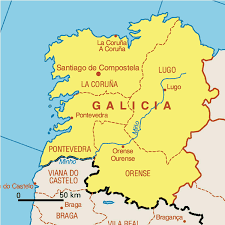
It is to the city of Pontevedra in the province of Pontevedra that we journeyed to celebrate the birthday of one of our party of four. The plan was to take to the sea and enjoy the natural delights of Galicia’s only national park, Parque Nacional Marítimo-Terrestre das Illas Atlánticas de Galicia, a series of islands each located at the mouth of one of the four Rias Baixas.

One of our party of four.
The Rias Baixas (pronounced RI-as BY-shas) are a series of estuarine ecosystems on the southwestern coast of Galicia. As you know from your earth science class, an estuary is “a partially enclosed body of water, and its surrounding coastal habitats, where salt water from the ocean typically mixes with fresh water from rivers or streams” (Mr. Portello, 7th grade, Neal Junior High School).
On 14 July we drove to Portonovo, expressed a difference of opinion with a ticket agent regarding the validity of our previous on-line ticket purchase, then boarded a ferry for the beautiful island of Ons, located at the mouth of the Ría Pontevedra.

The beautiful Ons Island.
“Illa de Ons” in Galego, “Ons Island” in English, “Isla de Ons” in Castellano, or “Ons Uhartea” in Basque — no matter how you pronounce it, the place is delightful. Getting up in time to drive to the ferry, anxiously scouting a parking spot, rushing to the pier, standing in line to process our tickets, disagreeing with the ticket agent (aforementioned), positioning ourselves for optimum seating on the ferry, and riding the chop of the waves to our destination — all mere appetizers for what awaited us on “Iscla de Ons” (Occitan).


As it was someone’s birthday, expectations were high! And with expectations high, there was only one direction in which they would go.


Illa de Ons is beautiful. If you want, you can take off all your clothes at many of the numerous beaches. (We did not.) You can stay over night and camp. (We did not.) You can drink a beer and eat an ice cream at a quiet café. (We did.) You can learn stuff. (We did.) You can make amends and feel good about each other by the end of the day. (We did.)


Because we couldn’t get enough of the warm sand, hot sun, and frigid waters where the rivers of the Rias Baixas converge with the waves of the North Atlantic Ocean, the following day we proceeded to another magnificent landmass, A Illa de Arousa (Las Isla de Arosa in Castellano), the only island municipality in Galicia.
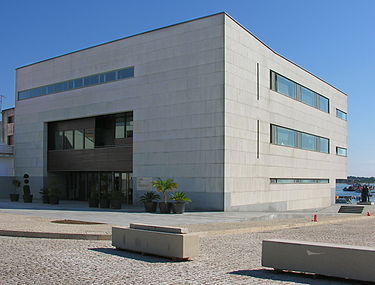
You Cannot Fight This Establishment: Concello da llla de Arousa: City Hall.
It is located somewhere on this island.
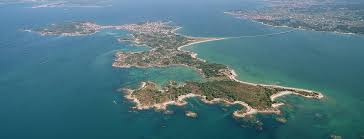
A road connects the main land to the not main land.
We made our way to Playa Sualaxe, one of more than fifteen beaches on the island. A boardwalk, bathrooms, beach umbrellas, canoes and paddle boats were available for use, along with the ubiquitous café. A game of volleyball/soccer was easy to join, if one belonged to the proper age group.


We drove all around the island, searching for el Faro de Punta Cabalo. We discovered that this lighthouse is situated quite close to Playa Sualaxe and that we had been lounging right next to it all day long, the landmark being hidden by some pesky rocks.


We wanted each day to last forever, to grab hold of Sir Arthur Eddington’s “arrow of time” and snap it in two, as impossible a wish as to find a restaurant in Pontevedra later that evening that did not serve jamon.


We settled, instead, for the illusion of time passing, and dinner at a chain restaurant that served cheese pizza and green salad in the centro histórico district of Pontevedra. All in all, not so bad.
 pomegranate2015